As the dust settles on the busiest climbing season Mt. Everest has ever witnessed, the Sagarmatha Pollution Control Committee (SPCC) has concluded its Spring 2026 cleanup campaign with an impressive 90,329 kg of waste removed from the world’s highest mountain. The achievement highlights SPCC’s ongoing commitment to environmental conservation and confirms that Everest Rangers will remain a central part of its future strategy.
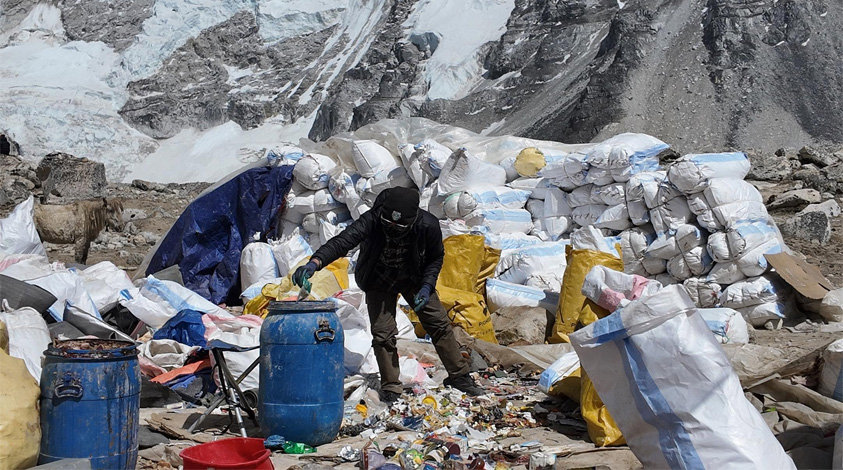
Of the total waste collected, 80,579 kg was removed from the Everest Base Camp area, including 34,239 kg of human waste, 21,603 kg of kitchen waste, 19,238 kg of mixed waste, and 5,499 kg of recyclable materials. An additional 9,750 kg of waste was brought down from above Base Camp, consisting of 4,964 kg of recyclable waste and 4,786 kg of mixed waste. Furthermore, 1,769 poop bags were transported down from the higher camps.
A New Era of Monitoring on Everest
The cleanup campaign followed stricter waste management regulations introduced by SPCC in March 2026. Supported by Nepal’s Department of Tourism (DoT) under the Ministry of Culture, Tourism and Civil Aviation, climbers were required to bring back at least 2 kg of waste from above Camp II, in addition to the existing 8 kg waste collection requirement at Base Camp.
To enforce the rule, SPCC established a dedicated Everest Rangers Base at Camp II, where monitoring staff verified that climbers were carrying waste down from Camp III and Camp IV rather than collecting it from lower sections of the mountain.
“As the Sagarmatha cleanup directives of the Nepal Government have endorsed Everest Rangers, SPCC is committed to implementing them,” said SPCC CEO Tshering Sherpa.
Following the successful implementation of the system during one of Everest’s busiest climbing seasons, SPCC plans to expand ranger operations to Camp IV on the South Col in 2027. The South Col has long been considered one of the most polluted areas on Everest.
Busiest Season, Biggest Cleanup Effort
The cleanup operation coincided with record-breaking climbing activity in the Khumbu region. According to SPCC, Spring 2026 saw 701 climbers on Mt. Everest, Mt. Lhotse, and Mt. Nuptse combined, making it the busiest climbing season ever recorded.
Despite the increased traffic, SPCC’s waste management team successfully recovered 1,226 kg of non-recyclable waste from Camp III and the South Col, along with 210 empty EPI gas canisters. Additionally, 6,522 kg of waste, including plastics, metal cans, tents, ropes, and kitchen materials, passed through SPCC’s Khumbu Icefall checkpoint during the season.
SPCC also recognized the dedication of its field staff, describing this year’s operation as its largest waste management effort to date. The organization praised team members who temporarily left their waste-monitoring duties to assist in the search for missing guide Hillary Dawa Sherpa, who survived after spending several days stranded in Everest’s Death Zone.
“That’s the spirit of SPCC,” the organization stated while thanking its staff for their outstanding efforts throughout the season.
Part of a Broader Environmental Initiative
The expansion of Everest Rangers and the record waste collection figures are part of SPCC’s broader environmental strategy. Through its “Everest 1° Initiative,” launched in partnership with the Cimex BYD Charity Foundation (CBCF) on World Environment Day, SPCC established the Camp II Rangers Base and installed a 5 KVA solar photovoltaic system at Everest Base Camp to reduce reliance on conventional fuels.
The initiative builds upon a successful 2025 drone pilot project conducted with Airlift Technologies, during which 283 kg of waste was airlifted from Camp I. The project demonstrated how drone technology can support waste management and logistics at extreme altitudes.
“More than 80 tonnes of waste, oxygen cylinders, plastics, climbing equipment, and human waste remain on the mountain, threatening glaciers, water sources, and local communities,” said Cimex Inc. Chairman Anil Shrestha.
SPCC and CBCF are now working to introduce climber environmental orientation programs, establish waste management facilities at higher camps, and expand drone-assisted transport systems in future climbing seasons.
Sherpa also confirmed that SPCC has partnered with Airlift Technologies to use drones for transporting supplies to higher camps and bringing waste back to Everest Base Camp.
“Drones are extremely helpful for transporting garbage and supporting expeditions on Mt. Everest,” Sherpa said. He added that SPCC plans to operate its own drone fleet to strengthen its environmental conservation efforts.
According to Sherpa, Everest Rangers will continue to play a crucial role in maintaining cleanliness and protecting the fragile ecosystem of the world’s highest mountain.
Founded in 1991 by local Sherpa communities, SPCC has managed waste control initiatives throughout Sagarmatha National Park for more than three decades. Since 1997, it has also overseen the maintenance of the Khumbu Icefall Route through its renowned Icefall Doctors team.
With Spring 2026 ending as both the busiest and one of the cleanest climbing seasons on record, SPCC’s next challenge will be extending its ranger-based waste management system all the way to the South Col and beyond.