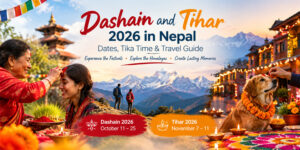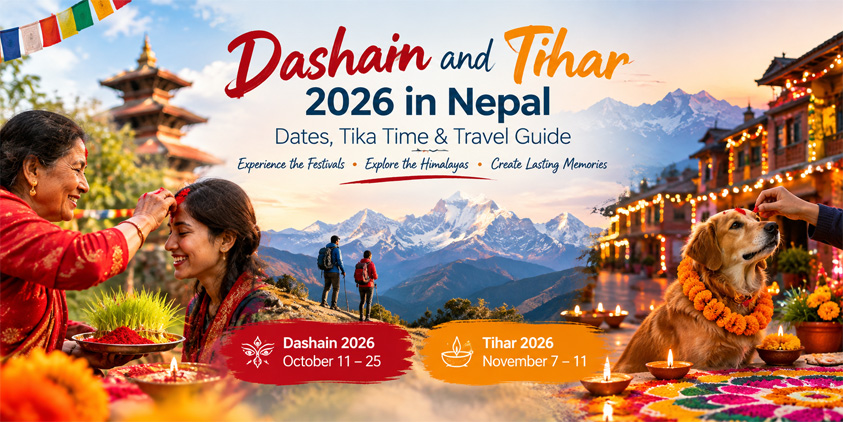
If you are planning to travel, trek, or take a cultural tour in Nepal during October or November 2026, you will be visiting at one of the most interesting times of the year. Nepal’s two biggest festivals, Dashain and Tihar, take place during this period, bringing family gatherings, religious ceremonies, colorful decorations, traditional music, feasts, lights, and celebrations throughout the country.
For travelers, these festivals are much more than public holidays. They offer an opportunity to see everyday Nepalese life at its most traditional and festive. You may see families returning to their home villages, temples filled with devotees, houses decorated with flowers and lamps, children singing Deusi and Bhailo, and people wearing new clothes and receiving blessings from their elders.
At the same time, festival travel requires a little extra planning. Public transportation becomes extremely busy, domestic flights can be in high demand, some businesses operate on reduced schedules, and many local people travel away from Kathmandu to celebrate with their families.
This guide explains the 2026 Dashain and Tihar dates, important festival days, Tika information, temple experiences, travel considerations, and ways visitors can enjoy Nepal’s festival season respectfully.
Dashain 2026: Nepal’s Biggest Festival
Dashain, also known as Bada Dashain, is Nepal’s longest and most important Hindu festival. It is traditionally celebrated over about two weeks and is dedicated primarily to Goddess Durga, symbolizing the triumph of good over evil.
Dashain is also a major family festival. People travel across Nepal to return to their ancestral homes, spend time with relatives, receive blessings from elders, eat traditional food, fly kites, play on traditional swings, and enjoy time together.
The first day, Ghatasthapana, falls on Sunday, October 11, 2026, and the festival reaches its best-known celebration on Vijaya Dashami, Wednesday, October 21, 2026. The formal festival period continues until Kojagrat Purnima on Sunday, October 25.
Dashain 2026 at a Glance
| Festival day | Date | Main event |
| Day 1 | October 11, 2026 | Ghatasthapana |
| Day 2 | October 12 | Navratri worship continues |
| Day 3 | October 13 | Navratri worship |
| Day 4 | October 14 | Navratri worship |
| Day 5 | October 15 | Navratri worship |
| Day 6 | October 16 | Navratri worship |
| Day 7 | October 17 | Phulpati |
| Day 8 | October 18 | Maha Ashtami |
| Day 9 | October 19–20 | Maha Navami rituals / festival holiday period |
| Day 10 | October 21 | Vijaya Dashami – Tika & Jamara |
| Day 11 | October 22 | Ekadashi |
| Day 12 | October 23 | Dwadashi |
| Day 13 | October 24 | Dashain continues |
| Day 14 | October 25 | Kojagrat Purnima / final day |
The lunar calendar means that some rituals and tithis do not correspond perfectly to a simple one-day-per-number sequence. For practical travel planning, the major dates are October 11, 17, 18, 19–21 and October 25. Nepal’s official holiday calendar and Nepali calendars should be checked close to departure for final local observances.
October 11 – Ghatasthapana
Ghatasthapana marks the beginning of Dashain and Navratri.
Families establish a sacred kalash and sow barley seeds in a protected place to grow Jamara, the yellow-green shoots that are later placed together with Tika on the forehead of family members.
For visitors, this is an excellent time to begin experiencing Dashain because the festival atmosphere gradually develops during the following days. The Nepal Tourism Board describes Ghatasthapana, Phulpati, Maha Ashtami, Maha Navami and Vijaya Dashami as the major sequence of Dashain rituals.
October 17 – Phulpati
Phulpati, the seventh day of Dashain, falls on Saturday, October 17, 2026.
Phulpati is one of the most important public days of Dashain. Sacred flowers, leaves and other auspicious plants are traditionally brought into homes, while Kathmandu hosts the ceremonial arrival of Phulpati associated with Hanuman Dhoka.
Travelers staying in Kathmandu during this period can experience the festival atmosphere around Kathmandu Durbar Square and Hanuman Dhoka, although access to particular ceremonies can be restricted.
Phulpati is also the point when the festival becomes particularly visible in public life, and many Nepalese begin their main holiday travel around this time.
October 18 – Maha Ashtami
Maha Ashtami, the eighth day of Dashain, falls on Sunday, October 18, 2026.
This is one of the major days of worship dedicated to Goddess Durga. Temples and Shakti shrines become especially busy, and traditional rituals are performed in many parts of Nepal.
Visitors should be aware that some Dashain rituals involve animal sacrifice. These ceremonies are religious traditions and may be confronting for travelers unfamiliar with them. If you prefer not to witness such activities, your guide can arrange alternative cultural experiences.
October 19–20 – Maha Navami and the Main Temple Rituals
The Dashain calendar can look confusing because the lunar tithi does not always match the Gregorian date in a straightforward way. In Kathmandu, Navami-related rituals extend across this period, while Maha Navami is observed as a major festival day.
Taleju Bhawani Temple – A Rare Dashain Experience
One of the most remarkable Dashain traditions in Kathmandu is the opening of Taleju Bhawani Temple at Hanuman Dhoka.
The temple is normally closed to the general public and traditionally opens to devotees only once a year during Maha Navami. The Nepal Tourism Board also identifies the ninth day as the occasion when the normally restricted Taleju Temple opens to the public.
Large crowds gather for this opportunity, so visitors should expect queues and follow the instructions of temple authorities.
Important: Entry into the inner temple is subject to religious and access restrictions. The surrounding Kathmandu Durbar Square remains an important place to experience the atmosphere even if you cannot enter the temple itself.
October 21 – Vijaya Dashami: Dashain Tika Day
Vijaya Dashami falls on Wednesday, October 21, 2026.
This is the most important day for many Nepali families. Elders place Tika and Jamara on younger family members’ foreheads and give blessings. Families visit relatives, share meals, exchange gifts, and spend the day together.
Tika is traditionally made from a mixture involving red vermilion, yogurt and rice, while Jamara grown since Ghatasthapana represents prosperity and blessing.
What time is Dashain Tika in 2026?
The date of Vijaya Dashami is confirmed as October 21, 2026. The precise auspicious Tika Sait (muhurat) for 2083 BS should be checked against the final announcement from the Nepal Panchanga Nirnayak Development Committee before publication or travel.
Do not confuse the frequently quoted 11:53 AM with the 2026 official time. 11:53 AM was the published auspicious Tika time for Dashain 2082/2025, not a confirmed 2026 time.
For ordinary family celebrations, people do not necessarily wait for the nationally announced sait. Vijaya Dashami itself is considered an auspicious day, and Tika is traditionally received throughout the day and during the following days.
Travel tip: If you want to experience Tika personally, arrange this in advance with a Nepali family, host, guide, or local contact rather than assuming that a temple or hotel will provide it.
October 22–25 – Dashain Continues
Dashain does not end immediately after Tika.
People continue visiting relatives and receiving blessings during the following days. The festival traditionally concludes with Kojagrat Purnima on October 25, 2026.
For travelers, the days after Vijaya Dashami can actually be a quieter time in some tourist areas because many Nepalese have already returned to their homes or completed their family visits.
Tihar 2026 – The Festival of Lights
Shortly after Dashain comes Tihar, one of the most colorful festivals in Nepal.
Tihar is often called the Festival of Lights because homes, shops, streets and neighborhoods are decorated with oil lamps (diyas), candles and electric lights. Doorways are decorated with rangoli, and marigold flowers are used throughout the festival.
Tihar is associated with Yama, the god of death, and Laxmi, the goddess of wealth and prosperity. Each day has its own special meaning and relationship with animals, family and spiritual traditions.
In 2026, the main Tihar period falls in early November, with Kag Tihar on November 7 and Bhai Tika on November 11 in the Nepali calendar used for 2083. Some rituals overlap because they are determined by lunar tithi, so different calendars may display slightly different descriptions of individual days.
Tihar 2026 Dates
| Date | Festival | What happens |
| November 7, 2026 | Kag Tihar | Crows are offered food |
| November 8 | Kukur Tihar / Laxmi Puja | Dogs are honored; homes and businesses prepare for Laxmi Puja |
| November 9 | Gai Tihar / Govardhan-related celebrations | Cows and cattle are honored; traditions vary by community |
| November 10 | Govardhan Puja / Mha Puja | Cattle worship and Newar Mha Puja traditions |
| November 11 | Bhai Tika / Kija Puja | Brothers and sisters exchange Tika and blessings |
The exact combination of rituals can vary between communities, and some calendars list overlapping observances on the same date. The Nepal Panchanga calendar and government holiday notices should be used for final scheduling.
Kag Tihar – November 7
The first day of Tihar is Kag Tihar, when crows are traditionally offered food.
Crows are associated with Yama, and the ritual is intended to maintain harmony and ward off misfortune.
For travelers, this is a quieter beginning to Tihar, while the visual atmosphere becomes increasingly colorful over the following days.
Kukur Tihar – November 8
Kukur Tihar is one of Nepal’s most distinctive festival traditions.
Dogs are decorated with marigold garlands, given Tika and offered special food. The tradition recognizes dogs for their loyalty and their symbolic connection with Yama.
Travelers often find this one of the most memorable cultural experiences in Nepal. You may see families decorating their own dogs as well as offering flowers and food to street dogs.
If photographing people and their animals, it is always better to ask permission first.
Laxmi Puja – November 8
Laxmi Puja is the most famous evening of Tihar.
Homes, shops, offices and businesses are thoroughly cleaned and decorated before evening prayers. People light oil lamps, candles and electric lights, while colorful rangoli designs decorate entrances.
A traditional belief is that the lights and decorations invite Goddess Laxmi, the goddess of wealth and prosperity, into the home.
Kathmandu becomes particularly beautiful after sunset during this celebration.
Visitors staying in Kathmandu, Patan, Bhaktapur or other towns and cities can enjoy the illuminated streets, decorated homes and festive atmosphere. The exact combination of Kukur Tihar and Laxmi Puja on the calendar reflects overlapping lunar observances in 2026.
Deusi and Bhailo – Tihar at Night
One of the most enjoyable parts of Tihar for visitors is Deusi and Bhailo.
Groups of children and young people visit neighborhoods singing traditional songs, dancing and offering festive greetings. In return, households give them money, fruit, sweets and other treats.
The streets can become lively after dark, with music, lights, flowers and groups moving from house to house.
For travelers, it is a wonderful opportunity to experience Nepalese community life. Rather than treating it as a performance arranged for tourists, enjoy it respectfully as a living local tradition.
Mha Puja and Govardhan Puja
The following day includes several traditions depending on community.
Govardhan Puja honors Govardhan and is associated with cattle and agricultural life. In many places, cows and oxen are decorated and worshipped.
Among the Newar community of the Kathmandu Valley, Mha Puja is an important ritual of self-worship and spiritual renewal. It is particularly significant in Kathmandu, Patan and Bhaktapur.
If you are interested in Newar culture, Tihar is an excellent opportunity to combine the festival with a cultural tour of the Kathmandu Valley.
Bhai Tika – November 11
Bhai Tika, also called Kija Puja in the Newar tradition, is the final major day of Tihar.
Sisters traditionally place a special Tika on their brothers and offer blessings for their long lives and prosperity. Brothers in turn offer gifts to their sisters.
The ceremony is intimate and family-centered, so travelers should not expect it to be a public spectacle. However, if you have Nepalese friends or are staying with a host family, you may be invited to participate.
The 2026 calendar places Bhai Tika on Wednesday, November 11.
Does Dashain and Tihar Affect Travel in Nepal?
Yes, especially on the main festival days, such as Vijaya Dashami – Tika & Jamara on October 21 and Bhai Tika / Kija Puja on November 11. However, this does not mean you should avoid traveling to Nepal during the festival season.
During these important days, many Nepalese travel to their hometowns to celebrate with family, so roads and public transportation can become busier than usual. Some shops, offices, banks, and local businesses may also close or operate on reduced hours.
For travelers, however, the festivals can be a wonderful opportunity to experience Nepal’s rich culture and traditions. With a little advance planning and a flexible itinerary, you can enjoy your trek or tour while also experiencing the colorful celebrations of Dashain and Tihar.
Dashain is the biggest annual family migration in Nepal. Hundreds of thousands of people travel from Kathmandu and other cities to their home districts.
Roads, buses and public transportation can therefore become extremely busy, particularly before and after the main Dashain holidays.
If you are traveling by road, allow additional time and avoid making very tight connections.
Flights to popular destinations such as Lukla, Pokhara and other trekking gateways can be in high demand around the festival period.
If your trekking itinerary involves a domestic flight, book as early as practical and allow some flexibility for weather or operational changes.
During the main Dashain holidays, government offices, banks, schools and many privately owned businesses close or reduce their services.
Restaurants and hotels in major tourist areas generally continue serving travelers, but individual businesses may have different holiday schedules.
Your tour operator should confirm important services such as airport transfers, permits, domestic flights, guides and transportation before your arrival.
Dashain and Tihar do not automatically close Nepal’s major trekking routes.
October and November are generally among the most popular trekking months because the monsoon has normally ended and the weather often becomes drier with good mountain visibility.
However, festival dates can affect the availability of individual guides, porters, drivers and lodge staff because many Nepalese also want to spend the holidays with their families.
For a trekking trip during Dashain or Tihar, arrange your guide, porter, transportation, permits and accommodation in advance.
There is an interesting contrast during Dashain.
While the roads leaving Kathmandu can become extremely busy, parts of Kathmandu itself can become quieter as residents leave the capital to visit their families.
This can provide a different experience of the city, although some local businesses and services may be closed.
What Can Travelers Experience During Dashain?
You do not have to be Hindu to appreciate Dashain.
Travelers can experience:
The Nepal Tourism Board specifically notes family reunions, gifts, blessings, feasts, temple visits, kite flying and traditional swings among the characteristic experiences of Dashain.
What Can Travelers Experience During Tihar?
Tihar is particularly rewarding for travelers interested in photography, local culture and evening experiences.
Look for:
The best experience is often simply walking through a residential neighborhood with a local guide or host and observing how families prepare their homes.
Is October and November a Good Time to Trek in Nepal?
For many travelers, October and November are among the most popular months for trekking and touring in Nepal.
The summer monsoon has generally ended, temperatures are comfortable in many trekking areas, and mountain views are often excellent.
The higher trekking regions can become cold, especially at night, so appropriate clothing is still important.
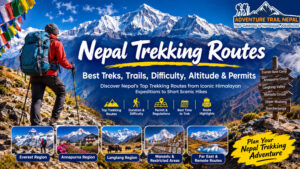
Popular trekking choices during this period include:
October can still experience occasional unsettled weather, particularly around the transition from the monsoon season, so travelers should keep some flexibility in their itinerary.
Tips for Traveling Nepal During Dashain and Tihar
Book early
Hotels, domestic flights, tourist buses, private vehicles and trekking services can become busy around the major festival dates.
Keep your itinerary flexible
Avoid scheduling an important international flight immediately after a long road journey during the busiest Dashain travel period.
Carry some cash
Banks and some financial services may close during public holidays. Having sufficient Nepalese rupees is useful, particularly when traveling outside major tourist centers.
Ask before entering temples or ceremonies
Not every temple area or ritual is open to visitors. Some ceremonies are reserved for devotees or particular communities.
Dress respectfully
When visiting temples and participating in local celebrations, modest clothing is appreciated.
Be sensitive when photographing rituals
Always ask before photographing people, especially during private family ceremonies or religious rituals.
Do not assume every festival is a tourist show
Dashain and Tihar are living religious and family traditions. Experiencing them respectfully means observing local customs rather than expecting everything to be arranged for visitors.
Confirm festival dates close to departure
Nepal follows a lunisolar calendar, and festival dates are determined according to tithi. For important ceremonies and auspicious times, check the latest information from the Nepal Panchanga Nirnayak Development Committee or your local Nepal travel operator.
Should You Travel to Nepal During Dashain and Tihar?
Absolutely, if you are interested in experiencing Nepal beyond its mountains and monuments.
The festival season adds another dimension to a Nepal trip.
You can trek through the Himalayas during the beautiful autumn season and then return to Kathmandu to see homes illuminated for Tihar. You can visit historic squares, watch local celebrations, experience traditional food and, if invited, receive Tika and Jamara from a Nepali family.
The festivals may require a little more planning, but they can also make your journey more memorable.
For trekkers, October and November combine favorable autumn trekking conditions with an opportunity to experience two of Nepal’s most important cultural celebrations.
Instead of worrying that Dashain and Tihar will disrupt your Nepal trip, plan around them and experience the country at a particularly special time of year.
Plan Your Nepal Festival & Trekking Holiday
If you are planning to visit Nepal during Dashain or Tihar 2026, we recommend arranging your transportation, accommodation, trekking guide and domestic flights in advance.
A private itinerary also makes it easier to adjust your travel dates around the main festival days and include local cultural experiences along the way.
Whether you are interested in a Himalayan trek, Kathmandu Valley cultural tour, wildlife safari, Pokhara holiday or a tailor-made Nepal adventure, the festival season can be incorporated into your itinerary.
Experience Nepal’s mountains, culture and festivals in one memorable journey.