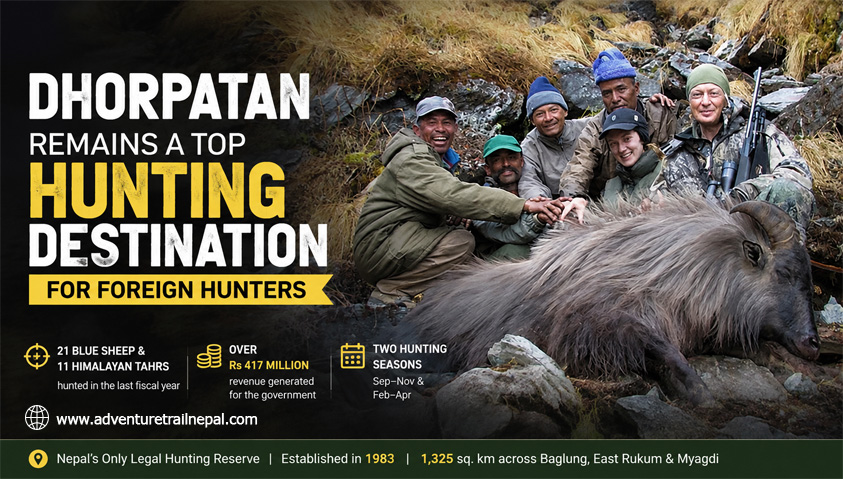
Dhorpatan Hunting Reserve, Nepal’s only legally designated hunting reserve, continues to attract international hunters interested in pursuing blue sheep (bharal) and Himalayan tahr in the high Himalayas.
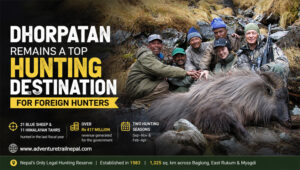
During the last fiscal year, foreign hunters successfully hunted 21 blue sheep and 11 Himalayan tahrs, generating more than Rs 417 million in government revenue through competitive bidding for hunting permits.
Foreign Hunters Generate Millions in Government Revenue
Hunting in Dhorpatan is conducted during two designated seasons each year. During the first hunting season, which runs from September to November, hunters paid approximately Rs 303.05 million in government revenue. A further Rs 143.74 million was generated during the second season, from February to April.
According to reserve ranger Sagar Subedi, permits were issued for 11 blue sheep and eight Himalayan tahrs during the first season. Foreign hunters successfully hunted eight blue sheep and five Himalayan tahrs.
However, three blue sheep and three Himalayan tahrs could not be hunted despite the required permit fees having been paid.
During the second hunting season, permits were issued for 14 blue sheep and 10 Himalayan tahrs. Hunters successfully harvested 13 blue sheep and six Himalayan tahrs, while one blue sheep and four Himalayan tahrs remained unhunted.
Why Some Animals Are Not Hunted
Anannath Baral, chief conservation officer at the Dhorpatan Hunting Reserve Office, said several factors can prevent hunters from harvesting animals for which permits have already been issued.
Problems with ammunition, illness among hunters, changing weather conditions, difficult terrain and missed shots are among the common reasons.
Hunting in the reserve is conducted under strict regulations, with hunters accompanied by reserve staff and Nepal Army personnel in designated hunting areas.
Dhorpatan Hunting Seasons and Hunting Blocks
Dhorpatan is the only location in Nepal where regulated sport hunting is legally permitted. Foreign hunters pay substantial fees through a competitive bidding system to obtain permits for blue sheep and Himalayan tahr.
International hunters from countries including the United States, Spain, the Netherlands and Mexico regularly visit the reserve during the authorized hunting seasons.
The reserve is divided into seven designated hunting blocks:
The Department of National Parks and Wildlife Conservation (DNPWC) determines the annual hunting quota based on wildlife population surveys and conservation considerations.
The department also invites electronic bids for each hunting season to establish the hunting quota and applicable revenue rates.
Helicopter Access and High Expedition Costs
Commercial foreign hunting companies and international hunters generally travel to Dhorpatan by helicopter. Hunters are responsible for transportation, porters, guides, logistics, accommodation and other expedition-related expenses.
According to the reserve office, a hunter may spend approximately Rs 2 million to Rs 3.5 million during a 15-day hunting expedition, in addition to the applicable hunting permit and trophy fees.
The overall cost can be substantial when expenses for the animal, hunting block reservation, licence, helicopter transportation, support staff and other logistics are included.
Hunters, together with Nepal Army personnel and reserve staff, are permitted to remain in the forest for a maximum of 15 days during an expedition.
No Nepali Hunters Have Participated in the Bidding
Although Dhorpatan’s hunting programme attracts wealthy international hunters, the reserve office says that no Nepali hunter has so far participated in the competitive bidding process for blue sheep or Himalayan tahr hunting permits.
The programme is primarily targeted at international hunters and is managed under Nepal’s wildlife conservation regulations.
Established in 1983, Dhorpatan Hunting Reserve covers approximately 1,325 square kilometres across Baglung, East Rukum and Myagdi districts of western Nepal.
The reserve is known for its rugged Himalayan landscapes, high-altitude grasslands and diverse wildlife. Blue sheep and Himalayan tahr are among its most sought-after game species.
The controlled hunting programme provides significant government revenue while operating under annual wildlife quotas and regulated hunting seasons. The determination of hunting quotas by the national wildlife authorities is intended to ensure that hunting remains within established conservation limits.
With its combination of remote Himalayan terrain, challenging hunting conditions and regulated wildlife management, Dhorpatan remains one of Nepal’s most distinctive destinations for international hunters and a unique example of regulated hunting tourism in the country.