Mustang
14 Days
Easy to Moderate
2-30 Persons
3810m.
Spring and Autumn
Trekking / Hiking
Hotel & Tea House
Breakfast, Lunch & Dinner
Private Vehicle and Flight
Kathmandu
Kathmandu
The Upper Mustang Trek is a journey into the once-forbidden kingdom of Lo a hidden world of ancient Buddhist culture, dramatic desert landscapes, and timeless Himalayan beauty. Opened to foreign trekkers only in 1992, this restricted region preserves centuries-old Tibetan traditions, walled villages, and cliff-side monasteries untouched by modern influence.
Located beyond the Annapurna and Dhaulagiri ranges, Upper Mustang lies in a rain-shadow zone, making it one of the best trekking destinations even during the monsoon season. From the wind-eroded cliffs and red canyons to the whitewashed houses and prayer-flag-lined trails, every step reveals a landscape rich in culture and spirituality.
The highlight of the journey is Lo-Manthang, the ancient walled capital of Mustang, home to royal palaces, sacred gompas, and the friendly “Lobas” people who have kept their Tibetan heritage alive for centuries.
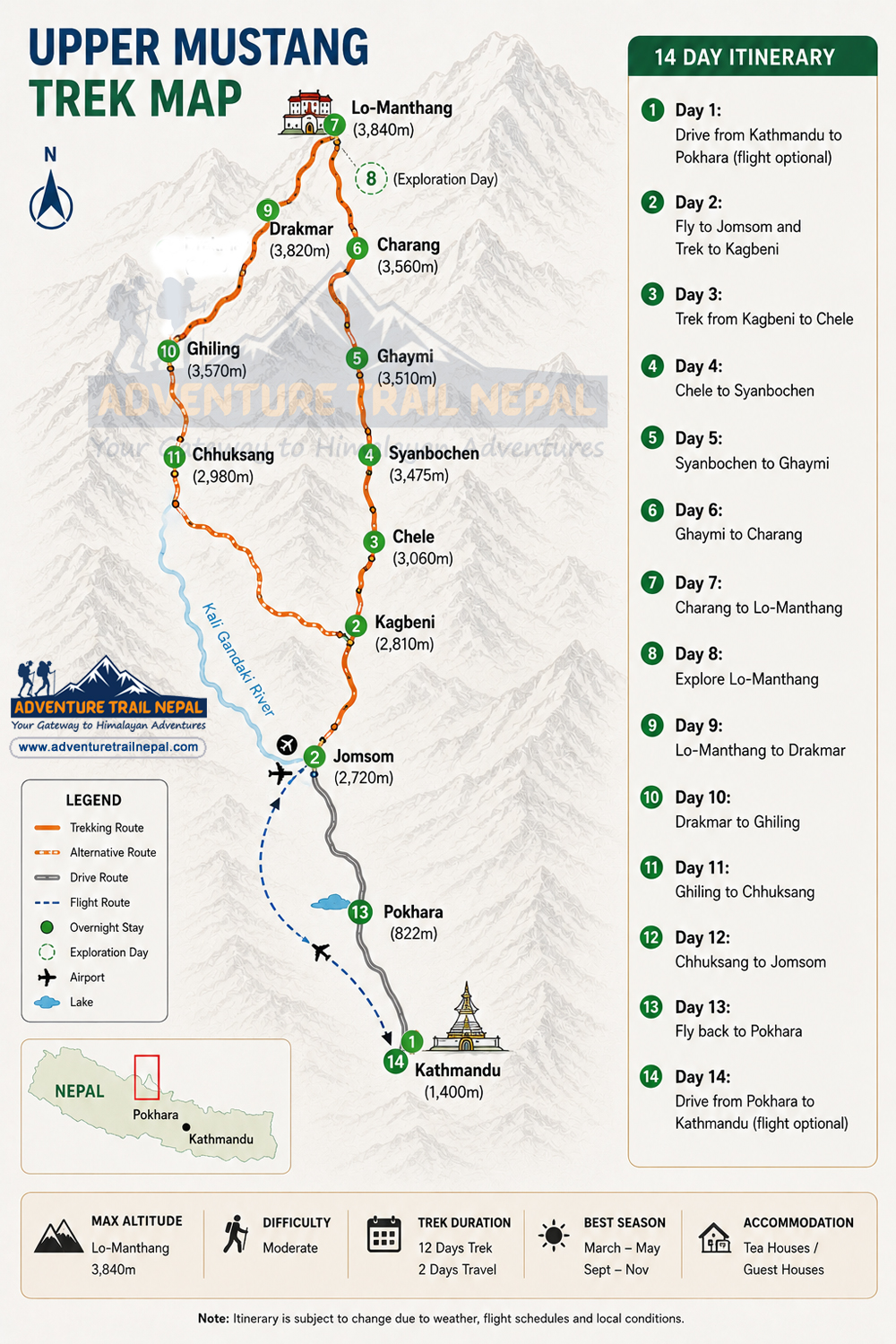
After breakfast, your guide will pick you up and transfer you to a tourist bus heading to Pokhara. The drive passes through lush hills, river valleys, and small towns. Upon arrival, check in at your hotel near the serene Phewa Lake. In the evening, stroll around Lakeside and enjoy Pokhara’s relaxing atmosphere.
Take an early morning flight to Jomsom (2,700m), offering stunning views of Annapurna and Dhaulagiri. After breakfast in Jomsom, begin your trek along the Kali Gandaki River. Pass Ekle Bhatti and reach Kagbeni, a beautiful village marking the gateway to Upper Mustang.
After breakfast, check your restricted area permits and officially enter Upper Mustang. Walk along the riverbank and pass traditional villages like Tangbe and Chhusang before crossing the Kali Gandaki River. A short climb takes you to Chele, a charming village with apple orchards and stone-built houses.
Climb up to Taklam La Pass (3,625m) and descend to Samar village, a popular stop for mule caravans. Continue through juniper forests and colorful chortens to reach Syanbochen, a peaceful village surrounded by hills.
Ascend to Yamda La Pass (3,845m) and Nyi La Pass (4,015m) before descending into the village of Ghaymi, surrounded by fields and ancient walls. Ghaymi is one of the largest villages in Upper Mustang.
Cross the Ghaymi Khola River and walk along a long Mani wall, beautifully decorated with Buddhist mantras. Reach Charang, known for its large red Gompa and whitewashed Dzong (fortress).
Trek through the Charang Chu Canyon and climb gently to the windy Lo Pass (3,950m). From here, you’ll get your first view of the walled city of Lo-Manthang, the ancient capital of Mustang.
Spend the day exploring the treasures of Lo-Manthang. Visit the Royal Palace, Jampa Lhakhang, Thubchen, Chodey, and Choprang Gompas. Wander through narrow alleys, interact with locals, and enjoy the ancient murals and art that make this city a living museum.
Leave Lo-Manthang via the upper trail, crossing the Dhi Pass (4,100m). Stop by Ghar Gompa, one of Mustang’s oldest monasteries, believed to grant wishes. Descend through red cliffs to reach Drakmar.
Descend early to avoid afternoon winds. Walk through arid fields to Ghiling, a quiet village offering impressive views of Dhaulagiri and Nilgiri.
Follow the ancient trail passing Chungsi Cave Monastery, where Guru Padmasambhava meditated. Cross deep valleys and reach Chhuksang, where the Upper Mustang route reconnects with Lower Mustang.
Trek back along the Kali Gandaki River, visiting Jharkot and Khingar villages. Arrive in Jomsom, where your trek concludes.
Take a scenic morning flight to Pokhara, passing between the massive Dhaulagiri and Annapurna ranges. Spend the rest of the day relaxing or sightseeing around Pokhara.
After breakfast, drive back to Kathmandu, where you’ll be treated to a farewell Nepali dinner hosted by the team.
Interested in this trip? Start planning your adventure today!
Additional Information for Upper Mustang Trek
Restricted Area Permit
Upper Mustang is a restricted area of Nepal, so trekkers need a special Restricted Area Permit (RAP) in addition to the Annapurna Conservation Area Permit (ACAP). The special permit must be arranged through a registered trekking agency, and independent trekking is not permitted in the Upper Mustang region.
Please bring a valid passport with sufficient validity and the required number of blank pages for the permits and other travel formalities. We will arrange the necessary trekking permits before you begin the trek.
Trek Equipment and Packing
Here is a general list of what you might want to pack for the trek. Please consider it a starting point and adjust it according to the season and your personal needs.
We provide a 75-liter duffel bag for the trek. It will be given to you during your pre-trip meeting in Kathmandu, and you can use it to pack the belongings that will be carried by our support staff or porters. The duffel bag is yours to keep after the trek.
You can also rent a sleeping bag and down jacket from us in Kathmandu for an additional USD 35 each.
Essential items generally include:
Upper Mustang can be particularly cold and windy at higher elevations, especially in the mornings and evenings, so warm layers are important even during the warmer months.
Altitude and Acclimatization
The Upper Mustang Trek involves significant changes in altitude. The trek reaches approximately 3,800–4,200 meters, depending on the route and side trips.
The landscape is generally dry and open, but the high altitude means that your body needs time to adjust. Our itinerary is designed with a gradual increase in elevation and appropriate overnight stops.
Walk at a comfortable pace, stay well hydrated, and avoid rushing to higher elevations. If you experience symptoms such as severe headache, dizziness, nausea, unusual tiredness or difficulty breathing, inform your guide immediately.
Weather and Best Time to Trek
Upper Mustang lies in the rain-shadow area of the Himalayas, making it much drier than many other trekking regions of Nepal. The main trekking season is generally from March to November.
Spring brings pleasant daytime temperatures and clear mountain views. Summer is also suitable because Upper Mustang receives relatively little monsoon rainfall compared with other parts of Nepal. Autumn normally offers stable weather and excellent visibility.
Winter can be very cold, with snow and freezing temperatures possible at higher elevations. Some lodges and services may also be limited during the coldest months.
Weather in the mountains can change quickly, so it is important to be prepared for both sunny and cold conditions.
Flights to and from Jomsom
Depending on your itinerary, you may travel between Pokhara and Jomsom by domestic flight. The flight is operated in mountainous terrain and is highly dependent on weather and visibility.
Morning flights generally have better operating conditions, but delays or cancellations can still occur because of strong winds, cloud, poor visibility or other operational reasons.
For this reason, we recommend keeping some flexibility in your travel schedule, particularly if you have an international flight immediately after returning from the trek.
In case of a flight cancellation, your guide and our office will assist with the available alternatives, which may include waiting for the next flight or arranging road transportation where practical.
Accommodation
Accommodation during the trek is provided in locally operated teahouses, lodges or guesthouses. Facilities are more basic than those available in Kathmandu and Pokhara.
Rooms are generally twin-sharing, and bathrooms may be shared, particularly in the more remote villages. Hot showers may be available at some lodges for an additional charge.
Electricity is available in many villages, but charging facilities can be limited and may involve an extra fee. We recommend carrying a power bank.
Meals and Drinking Water
Meals during the trek are served at local teahouses and lodges. Typical options include dal bhat, noodles, pasta, rice, potatoes, soups, Tibetan-style dishes, eggs and other simple meals.
Breakfast, lunch and dinner are included according to your trekking package.
Bottled and filtered drinking water may be available along the route. We recommend carrying a reusable water bottle and using water purification tablets, a filter or another suitable purification method when necessary.
Staying properly hydrated is especially important at higher elevations.
Internet and Mobile Connectivity
Mobile phone coverage and internet access are limited in some parts of Upper Mustang. Wi-Fi may be available at selected lodges, usually for an additional charge, but the connection can be slow or unreliable.
Please do not rely on continuous internet access during the trek. We recommend informing family or friends that communication may occasionally be unavailable.
Electricity and Charging
Electricity is available in most villages, but the supply may not be as reliable as in the cities. Charging electronic devices may cost extra at some lodges.
A power bank or portable battery is strongly recommended, especially if you use your phone for photography, navigation or communication.
Money and Expenses
There are limited banking facilities and ATMs once you leave the main towns. We strongly recommend carrying enough Nepali rupees in cash to cover personal expenses during the trek.
You may need additional cash for:
Guide and Porter Support
You will be accompanied by an experienced, licensed trekking guide who will manage the daily trekking arrangements, assist with accommodation and coordinate with local service providers.
Porters or support staff will carry the main trekking luggage. You should carry only a small daypack containing items you need during the day’s walk, such as water, a camera, sunscreen, warm layers and personal medication.
Travel Insurance
Travel insurance is strongly recommended for the Upper Mustang Trek. Your policy should cover trekking at the maximum altitude reached on your itinerary and include emergency medical treatment and evacuation where applicable.
Before travelling, carefully check the terms and conditions of your insurance policy, particularly regarding high-altitude trekking and emergency evacuation.
Responsible Travel
Upper Mustang is a culturally and environmentally sensitive region with a unique Tibetan-influenced heritage. Please respect local customs, traditions, monasteries and religious sites throughout the trek.
Avoid unnecessary use of plastic, carry your rubbish until you reach an appropriate disposal point, and use water and other local resources responsibly.
When visiting monasteries, ask your guide before taking photographs, particularly inside religious buildings. Dress respectfully and follow local customs.
Photography
Upper Mustang offers spectacular landscapes, ancient villages, monasteries, caves and traditional Tibetan-influenced architecture. Please carry extra memory cards and batteries if photography is important to you.
Always ask permission before photographing local people, monks or religious ceremonies.
Trekking Conditions
The trails in Upper Mustang pass through dry valleys, rocky terrain, ridges and mountain paths. Some sections can be dusty and exposed to strong winds.
Daily walking distances and durations vary depending on the itinerary, terrain and altitude. Although the trek does not require technical climbing skills, you should be comfortable walking for several hours a day on uneven mountain trails.
Good physical preparation and regular walking or hiking before the trek will make the experience more enjoyable.
Personal Medical Kit
We recommend bringing a small personal medical kit containing any regular medication you require, along with basic items such as blister treatment, pain relief, sunscreen, antiseptic wipes and any medication recommended by your doctor.
Please inform your guide about any medical condition or medication that may be important during the trek.
Emergency and Evacuation
Your guide will carry basic first-aid supplies and will assist in case of an emergency. If a serious medical problem occurs, our team will coordinate the appropriate evacuation arrangements depending on the location, weather and available transportation.
For this reason, comprehensive travel insurance with emergency evacuation coverage is strongly recommended.
Pre-Trek Meeting in Kathmandu
Before starting the trek, we will organize a pre-trip meeting in Kathmandu. During the meeting, your guide will provide important information about the trek, check your equipment and answer any last-minute questions.
This is also when you will receive your 75-liter duffel bag for packing your trekking belongings.
If you need to rent a sleeping bag or down jacket, we can arrange these during your stay in Kathmandu.
Important Note
Mountain trekking is an adventure, and conditions can sometimes change unexpectedly. Flight schedules, trekking times, accommodation and daily plans may need to be adjusted because of weather, trail conditions, local circumstances or other factors beyond our control.
Our experienced guide and local office team will make the necessary arrangements with your safety and overall trekking experience as the priority.
Yes, Upper Mustang is a restricted area. You’ll need a Restricted Area Permit (USD 500 for 10 days) and Annapurna Conservation Area Permit (ACAP).
The best time is from March to November, including the monsoon months (June–August) since the region lies in a rain shadow.
It’s a moderate trek, suitable for trekkers with good fitness levels. Daily walking is around 5–7 hours on dry, windy terrain.
If your trip aligns with the Tiji Festival (usually May), we can customize your dates to experience this colorful celebration in Lo-Manthang.
You’ll stay in local tea houses/lodges during the trek and 3-star hotels in Pokhara and Kathmandu (upgradable options available).
 Best Seller
The Manaslu Base Camp Trek is one of Nepal’s most breathtaking and adventurous trekking experiences,...
 Trek through high mountain passes
Kanchenjunga Trekking is a remote, wild, and exhilarating adventure that offers trekkers a unique experience...
 Best Seller
The Makalu Base Camp Trek is a premier trekking destination in Nepal, offering a spectacular...
 Best Seller
The Nar Phu Valley Trek is one of Nepal’s most spectacular off the beaten path...