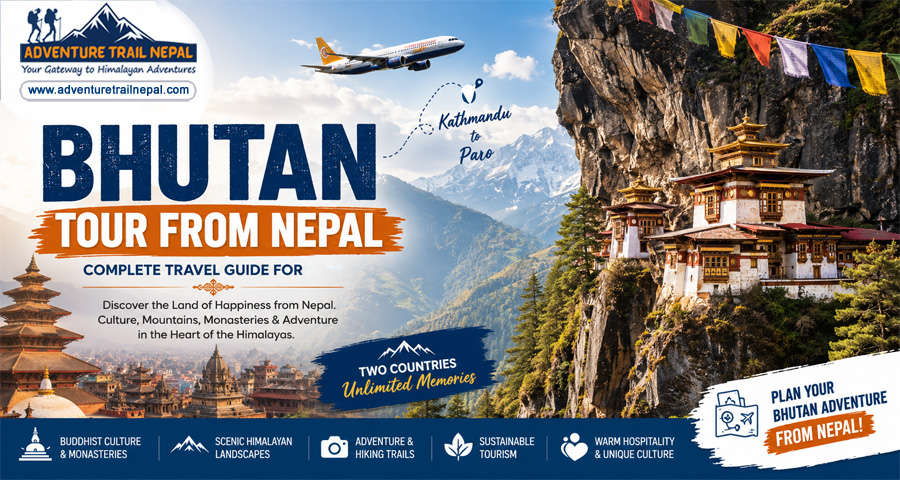
A Bhutan tour from Nepal is one of the most rewarding Himalayan travel experiences in South Asia. Combining Nepal’s ancient cities, Himalayan landscapes and adventure with Bhutan’s peaceful monasteries, dramatic valleys and distinctive Buddhist culture allows travelers to experience two fascinating Himalayan countries in one journey.
For travelers already visiting Kathmandu, Bhutan is particularly convenient because Kathmandu–Paro flights provide a direct air connection between Nepal and Bhutan. Current schedules vary by season, so flight availability should always be confirmed before booking.
Bhutan is also different from many conventional tourist destinations. Its tourism model focuses on high-value, low-impact tourism, with visitor spending contributing toward environmental conservation, cultural preservation, infrastructure and social development through the Sustainable Development Fee (SDF).
If you are planning a Bhutan trip from Nepal, this guide explains the essential information you need, including flights, visa requirements, SDF, weather, seasons, places to visit, accommodation, money, customs, travel tips and suggested itineraries.
Bhutan at a Glance
| Information | Details |
| Country | Kingdom of Bhutan |
| Capital | Thimphu |
| International Airport | Paro International Airport |
| National Language | Dzongkha |
| Currency | Bhutanese Ngultrum (BTN/NU) |
| Religion | Vajrayana Buddhism is the dominant religious tradition |
| Time Zone | Bhutan Time (BTT), UTC +6 |
| Tourism Policy | High-Value, Low-Impact Tourism |
| Country Code | +975 |
| Main Tourist Areas | Paro, Thimphu, Punakha, Wangdue, Phobjikha, Trongsa, Bumthang |
| Best-known Attraction | Tiger’s Nest Monastery (Paro Taktsang) |
| Main International Gateway | Paro |
| Main Language for Tourism | English is widely used in education and tourism |
Bhutan’s national language is Dzongkha, while English is widely understood because it is used throughout the country’s education system. Bhutanese Ngultrum is the national currency and is pegged 1:1 to the Indian rupee.
Key Facts About Bhutan
Bhutan is a small Himalayan kingdom located between Nepal, India and China. Unlike Nepal, which has a broad mass-tourism industry, Bhutan has deliberately developed a more controlled tourism model designed to protect its culture, environment and communities.
Official Religion and Culture
Vajrayana Buddhism has a profound influence on Bhutanese life, architecture, festivals and traditions. Dzongs, monasteries, prayer flags, chortens and Buddhist paintings are visible throughout the country.
Visitors should respect religious customs when entering monasteries and temples. Dress modestly, follow photography restrictions and walk clockwise around important Buddhist monuments when appropriate.
Bhutan Currency
Bhutan’s currency is the Bhutanese Ngultrum (BTN). The Ngultrum is pegged 1:1 to the Indian rupee. Banks, ATMs and credit-card facilities are available in larger towns, but carrying some cash is recommended when traveling into remote areas.
Language in Bhutan
Dzongkha is Bhutan’s national language. English is widely spoken and understood in tourism because it is part of the country’s education system.
Bhutan Tourism Philosophy
Bhutan is internationally known for its High-Value, Low-Impact Tourism philosophy. Rather than focusing on large numbers of visitors, Bhutan seeks to encourage tourism that contributes positively to the country’s economy, environment and cultural heritage.
Why Combine Nepal and Bhutan in One Trip?
A Nepal and Bhutan tour is ideal for travelers who want to experience two different sides of the Himalayas.
Nepal offers:
Bhutan offers:
The combination creates a well-balanced Himalayan holiday. You can explore the cultural heritage of Kathmandu, Bhaktapur and Patan, experience the Himalayas in Nepal, and then fly east to Bhutan for the valleys of Paro, Thimphu and Punakha.
For international travelers, Kathmandu can also be an excellent gateway for a multi-country Himalayan itinerary combining Nepal, Bhutan and Tibet, subject to current entry and travel regulations.
Travel Routes for a Bhutan Tour From Nepal
The easiest way to travel from Nepal to Bhutan is by air from Tribhuvan International Airport in Kathmandu (KTM) to Paro International Airport (PBH).
Drukair and Bhutan Airlines operates the Kathmandu – Paro route, with schedules changing according to the season. Nepal’s published 2026 international schedule confirms Drukair operations, while current route information also shows direct Kathmandu–Paro service.
The flight takes approximately 1½ hours, although the exact schedule and flight duration can vary.
This is usually the best option for travelers already in Kathmandu.
If a direct Kathmandu–Paro flight does not operate on your preferred date, an alternative is to travel through India and then fly to Bhutan.
Possible Indian gateways include:
Flight schedules are seasonal and subject to change, so travelers should check the latest airline schedules before finalizing their international itinerary.
Overland Entry to Bhutan via India
Travelers who want to experience Nepal, India and Bhutan in one journey can choose an overland route from eastern Nepal through India into Bhutan. Although this option takes longer than flying directly from Kathmandu to Paro, it offers an excellent opportunity to explore the landscapes and cultural highlights of three Himalayan destinations.
A convenient option is to fly from Kathmandu to Bhadrapur Airport (BDP) in eastern Nepal. From Bhadrapur, you can travel by private vehicle toward the Kakarbhitta–Panitanki border, crossing from Nepal into India. The journey through India toward the Jaigaon–Phuentsholing border takes approximately 4 hours, depending on road and border conditions.
After completing the India–Bhutan border formalities at Jaigaon–Phuentsholing, continue by road into Bhutan. The drive from Phuentsholing to Paro generally takes another 4–5 hours, depending on traffic, road conditions and stops along the way.
The approximate route is:
Kathmandu → Bhadrapur (flight) → Kakarbhitta/Panitanki Border → India → Jaigaon/Phuentsholing Border → Paro
Combine Sikkim and Darjeeling Before Bhutan
If you would also like to explore Darjeeling and Sikkim in eastern India before entering Bhutan, Adventure Trail Nepal can arrange a customized multi-country itinerary. Depending on your available time and interests, the Nepal–Darjeeling–Sikkim–Bhutan journey can be organized for approximately 3 days to 10–12 days, before continuing overland into Bhutan.
This option is ideal for travelers who want to experience the Himalayan landscapes, tea gardens and cultural heritage of Darjeeling, the mountain scenery and monasteries of Sikkim, and the unique Buddhist culture of Bhutan in one extended journey.
Adventure Trail Nepal can customize the route, accommodation, transportation, sightseeing and border arrangements according to your travel dates, interests and available time.
For travelers looking for the fastest and most convenient connection, Adventure Trail Nepal generally recommends the Kathmandu–Paro flight, subject to available flight schedules. However, the overland route through eastern Nepal, India, Darjeeling and Sikkim provides a more extensive and scenic multi-country Himalayan travel experience.
Another excellent option is to begin with a Nepal tour, continue to Bhutan by air, and then depart Bhutan through another international gateway.
For example:
International Arrival → Kathmandu → Pokhara → Chitwan → Kathmandu → Paro → Thimphu → Punakha → Paro → onward destination
This works particularly well for travelers who want to combine trekking, sightseeing and cultural experiences.
Bhutan Tour Visa and Entry Requirements
For most international visitors, a Bhutan visa must be obtained before traveling. Bhutan’s Department of Tourism states that visitors of all nationalities except Indian nationals require a visa; Bangladesh and Maldives passport holders have additional visa-on-arrival/application options.
Travelers can apply online, or a registered tourism operator can assist with the visa process.
What Travelers Generally Need
Before traveling, prepare:
Bhutan removed the mandatory travel-insurance requirement for visa processing in 2024, although the Department of Tourism continues to recommend travel insurance for international travelers.
Important: Immigration and visa rules can change. Always confirm the latest requirements before departure.
Bhutan Sustainable Development Fee (SDF)
The Sustainable Development Fee (SDF) is one of the most important things to understand before booking a Bhutan tour.
For most international tourists paying in US dollars, the current SDF is USD 100 per person per night. The 50% discounted rate was introduced in September 2023 and is scheduled to remain effective through 31 August 2027, subject to government policy changes.
The SDF is not simply an additional tourism tax. According to Bhutan’s Department of Tourism, revenue supports areas including:
Is the SDF Included in a Bhutan Tour Package?
It depends on the tour package and operator.
When requesting a quotation, always ask whether the price includes:
A professional tour operator should provide a clear cost breakdown.
Bhutan Visa Fee and SDF Are Different
Do not confuse the Bhutan visa fee with the Sustainable Development Fee.
The visa is an immigration requirement, while the SDF is a daily visitor contribution supporting Bhutan’s sustainable development objectives.
For an accurate quotation, ask your tour operator to show both separately.
Best Season for a Bhutan Tour From Nepal
Bhutan can be visited throughout the year. The country has four main seasons:
However, Bhutan’s climate varies considerably according to altitude and region.
Spring – March to May
Spring is one of the most attractive seasons for a Bhutan holiday.
Expect:
Spring is particularly appealing for travelers interested in nature and hiking.
Summer and Monsoon – June to August
Summer brings warmer temperatures and monsoon rainfall.
The southern and lower regions can be humid, while rain may affect roads and mountain travel. Bhutan’s Department of Tourism notes that the Indian monsoon primarily affects southern Bhutan from late June or July through late September.
The advantage is lush green landscapes and fewer tourists.
Autumn – September to November
Autumn is widely considered one of the best periods for a Bhutan tour.
You can expect:
Late September through November is especially popular among photographers, hikers and cultural travelers.
Winter – December to February
Winter brings crisp, dry weather and cold nights.
Higher areas can experience snow, while valleys such as Paro and Thimphu can have cold mornings and evenings. The Department of Tourism notes that snowfall is common above approximately 3,000 meters during winter.
Winter can be a great choice for travelers who prefer fewer visitors, clear skies and peaceful sightseeing.
Bhutan Temperature Guide
Bhutan’s temperature changes dramatically with elevation, so there is no single temperature range for the whole country.
| Season | Typical Conditions |
| Spring | Mild to warm in valleys; pleasant for hiking |
| Summer | Warm and wetter, especially during monsoon |
| Autumn | Mild days, cool evenings and generally clearer skies |
| Winter | Cold mornings and nights; snow at higher elevations |
In southern Bhutan, temperatures can range roughly from 15°C to 30°C year-round, while central and northern regions are considerably cooler because of elevation.
Always check the weather forecast for your specific destinations before traveling.
Best Places to Visit in Bhutan
Paro
Paro is the gateway to Bhutan for most international travelers and one of the country’s most scenic valleys.
Highlights include:
Tiger’s Nest Monastery
Paro Taktsang, commonly called Tiger’s Nest, is Bhutan’s most iconic attraction.
The monastery sits dramatically on a cliff above the Paro Valley. The hike normally takes several hours depending on fitness, pace and stops.
For many visitors, hiking to Tiger’s Nest is the highlight of their entire Bhutan trip.
Thimphu
Thimphu is Bhutan’s capital and cultural center.
Popular attractions include:
Punakha
Punakha is famous for its spectacular Punakha Dzong, located at the confluence of the Pho Chhu and Mo Chhu rivers.
The valley is warmer and more subtropical than Thimphu and Paro and is an important cultural destination.
Phobjikha Valley
Phobjikha is a peaceful Himalayan valley known for its landscapes and the endangered black-necked crane.
It is especially attractive for:
Bumthang
Bumthang is one of Bhutan’s most important spiritual and cultural regions, with ancient temples, monasteries and traditional villages.
A longer Bhutan itinerary can include Bumthang for a deeper cultural experience.
Popular Activities in Bhutan
A Bhutan tour is not only about sightseeing. Depending on your itinerary, you can enjoy:
Bhutan is also an excellent destination for travelers interested in responsible and nature-based tourism. The country has recorded more than 700 bird species and has strong environmental protection policies.
Accommodation in Bhutan
Bhutan offers accommodation ranging from luxury hotels and resorts to comfortable hotels and approved homestays.
The Department of Tourism states that tourist accommodation includes luxury five-star properties, hotels and traditional homestays, while tourist accommodation and campsites must meet Bhutan’s approval requirements.
When booking a tour, ask whether your package includes:
Food in Bhutan
Bhutanese cuisine is strongly influenced by rice, vegetables, cheese and chili.
Some dishes you may encounter include:
International and Indian-style food is also widely available in tourist areas.
Money and Credit Cards in Bhutan
You can exchange money at:
Visa and Mastercard are accepted in many urban locations, but card services may not always be available in remote areas. Carrying some Bhutanese currency is therefore recommended.
Internet, SIM Card and Communication
Mobile networks are available in the major towns and tourist areas, although coverage can become limited in remote mountain regions.
Travelers can obtain a local SIM card and use hotel Wi-Fi in most tourist destinations.
Bhutan’s international telephone code is +975.
Electricity and Power Plugs
Bhutan uses several types of electrical sockets, including British Type G, European Type C and Indian Type D sockets. Travelers should carry a universal travel adapter.
Is Bhutan Safe for Tourists?
Bhutan is generally considered a very safe destination for international travelers. The Department of Tourism describes Bhutan as a very safe country, although visitors should still take normal precautions and be aware of weather-related hazards such as flooding and landslides.
During the monsoon period, road travel can occasionally be affected by heavy rain, landslides and other weather conditions.
Travel insurance is strongly recommended even though it is no longer mandatory for visa processing.
Bhutan Travel Etiquette
Bhutan is a culturally conservative country, particularly around religious sites.
Travelers should:
Responsible behavior helps preserve Bhutan’s unique cultural identity.
What to Pack for Bhutan From Nepal
Your packing list depends on the season and altitude, but useful items include:
For the Tiger’s Nest hike, good walking shoes are particularly important.
How Many Days Do You Need in Bhutan?
For a first-time visitor, 4 – 7 days is a good duration for exploring the western part of Bhutan.
Paro – Thimphu – Punakha – Paro
This is suitable for travelers with limited time.
A longer itinerary can extend beyond western Bhutan toward:
When Should You Book a Bhutan Tour From Nepal?
Book your trip early if you plan to travel during:
Flights between Kathmandu and Paro have limited schedules compared with major international routes, so coordinating international flights with the Bhutan sector is important.
Because airline schedules can change, leave sufficient connection time when booking separate international tickets.
Bhutan Tour From Nepal: Practical Travel Tips
Bhutan Tour From Nepal: Frequently Asked Questions
Can I travel to Bhutan directly from Nepal?
Yes. Direct flights between Kathmandu and Paro operate on selected schedules, making Nepal one of the convenient gateways to Bhutan. Flight schedules should be confirmed for your travel dates.
Do Nepali citizens need a visa for Bhutan?
Bhutan’s general rule requires visitors, except Indian nationals, to obtain a visa before travel, with specific arrangements for Bangladesh and Maldives nationals. Travelers should verify the latest requirements for their passport nationality before booking.
How much is the Bhutan SDF?
For most international tourists paying in US dollars, the current SDF is USD 100 per person per night. The discounted rate is currently scheduled to continue until August 31, 2027, subject to government policy.
Is Bhutan expensive to visit?
Bhutan can cost more than many neighboring destinations because of the SDF and regulated tourism framework. However, the cost also supports sustainable development, conservation, infrastructure, cultural preservation and local communities.
What is the best month to visit Bhutan?
October and November are among the most popular months for clear weather and mountain views. March to May is another excellent period, especially for flowers, nature and hiking. Bhutan is nevertheless a year-round destination.
Is Bhutan suitable for families?
Yes. Bhutan can be an excellent family destination, particularly for families interested in culture, nature, history and outdoor activities. The itinerary can be adjusted to reduce long drives and strenuous hikes.
Is Tiger’s Nest difficult to hike?
The Tiger’s Nest hike is moderately demanding because of the elevation gain and altitude. Most reasonably fit travelers can complete it with sufficient time, but it is best to walk slowly, stay hydrated and take breaks.
Why Book a Bhutan Tour From Nepal With a Local Tour Operator?
Planning Bhutan independently requires coordination between visa processing, SDF payments, flights, accommodation, transportation and sightseeing.
A professional tour operator can help coordinate:
For travelers already exploring Nepal, combining Nepal and Bhutan with one travel company can also simplify flight coordination and ground arrangements.
Final Thoughts: Is a Bhutan Tour From Nepal Worth It?
Absolutely. A Bhutan tour from Nepal offers an exceptional opportunity to experience two distinctive Himalayan cultures in a single journey.
Nepal is famous for its dramatic mountains, trekking routes, temples, diverse communities and adventure activities, while Bhutan offers peaceful valleys, Buddhist spirituality, ancient dzongs, traditional architecture and a unique approach to sustainable tourism.
For travelers who have already planned a trip to Nepal, adding Bhutan from Kathmandu can transform an ordinary Himalayan holiday into a broader cultural and natural adventure.
Whether you have five days for a short Bhutan getaway or two weeks for a combined Nepal and Bhutan tour, careful planning around flights, visa requirements, SDF, weather and travel time will help you make the most of your journey.
Ready to explore Bhutan from Nepal? Plan your Himalayan adventure with a locally experienced travel company and discover the cultural heritage, mountain landscapes and peaceful atmosphere of Bhutan.