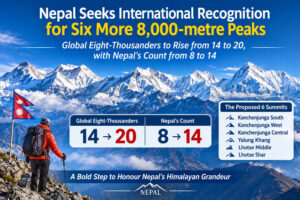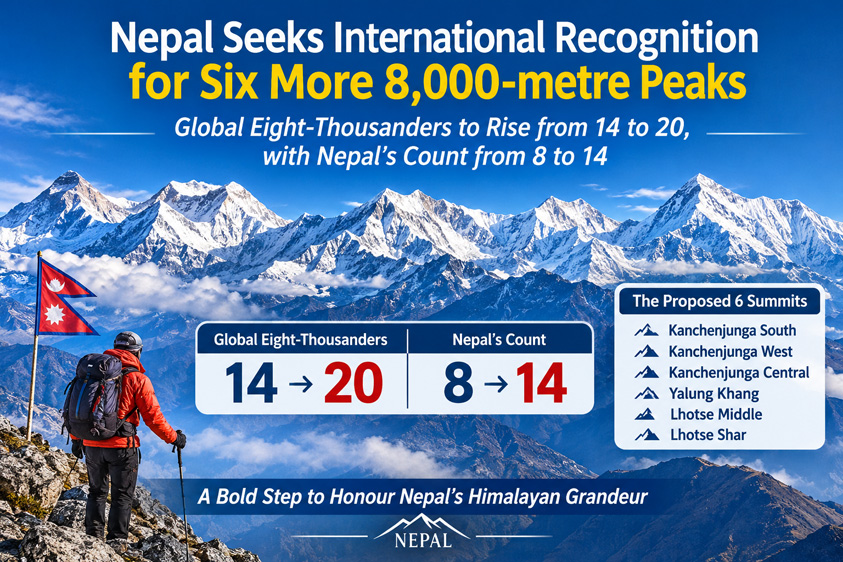
Nepal is seeking international recognition for six additional Himalayan summits above 8,000 metres as separate mountains. If approved, the proposal would increase the number of internationally recognised eight-thousanders worldwide from 14 to 20, while Nepal’s count would rise from eight to 14.
Speaking at the International Climbing and Mountaineering Federation (UIAA) General Assembly in Kathmandu, Nepal Mountaineering Association (NMA) President Fur Gelje Sherpa called for a formal assessment of the six summits based on geographical, scientific and mountaineering criteria.
Currently, eight of the world’s 14 internationally recognised mountains above 8,000 metres lie wholly or partly within Nepal. These include Mount Everest, Kanchenjunga, Lhotse, Makalu, Cho Oyu, Dhaulagiri I, Manaslu and Annapurna I.
The six proposed additions are Kanchenjunga South, Kanchenjunga West, Kanchenjunga Central and Yalung Khang in the Kanchenjunga range, along with Lhotse Middle and Lhotse Shar in the Everest–Lhotse range.
Six Himalayan Summits Await International Recognition
Although these summits are not yet internationally recognised as separate eight-thousanders, Nepal already issues climbing permits for them. Mountaineers who have successfully reached these summits have also received climbing certificates from the relevant authorities.
According to Sherpa, each summit has its own geographical identity, local name and distinct climbing route. Local communities also recognise them as separate mountains.
“Climbing one summit does not mean reaching another. Each presents a distinct mountaineering objective and requires its own expedition,” he said.
Sherpa further emphasised that climbing above 8,000 metres requires exceptional endurance, technical skills, experience and careful preparation. He argued that successfully reaching each individual summit represents a significant mountaineering achievement and deserves proper international recognition.
Nepal Forms an Expert Team to Support the Proposal
The Nepal Mountaineering Association has been raising the issue for several years. Previous NMA presidents and executive committee members have also called for international recognition of these additional summits, but the proposal has yet to receive the desired response.
To strengthen its case, the association has established an expert team that will prepare and present technical and scientific evidence supporting the recognition of the six summits as individual mountains.
Sherpa said five members of the team, led by Madhu Sudan Adhikari, would work on a detailed assessment explaining why each summit should be recognised separately.
“Our aim is not simply to increase the number of recognised mountains. We want to ensure that their distinct identities, local names, geographical characteristics and separate summit routes receive fair and professional consideration,” he said.
He also stressed the importance of reaching an international agreement on the scientific criteria for classifying a summit as a separate mountain. Sherpa called on Nepal to take a leading role in developing a clear and consistent framework for mountain classification across the Nepal Himalaya.
Nepal Hosts the UIAA General Assembly for the Third Time
The UIAA General Assembly, hosted by the Nepal Mountaineering Association in Kathmandu, has brought together 95 delegates from 45 countries representing five continents.
This is the third time Nepal has hosted the international gathering, following previous assemblies in 1982 and 2011.
The 1982 assembly in Kathmandu was particularly significant, as it adopted the Kathmandu Declaration. The declaration highlighted the importance of protecting mountain environments and natural resources while respecting the cultural heritage and traditions of mountain communities.
Nepal’s latest proposal represents an important step towards greater international recognition of its Himalayan peaks and mountaineering heritage. If successful, it would not only increase the country’s number of recognised eight-thousanders but also bring greater attention to the geographical diversity and mountaineering significance of the Nepal Himalaya.